If you export goods, the pallet you choose can decide whether your shipment clears the port smoothly or gets stuck waiting for paperwork.
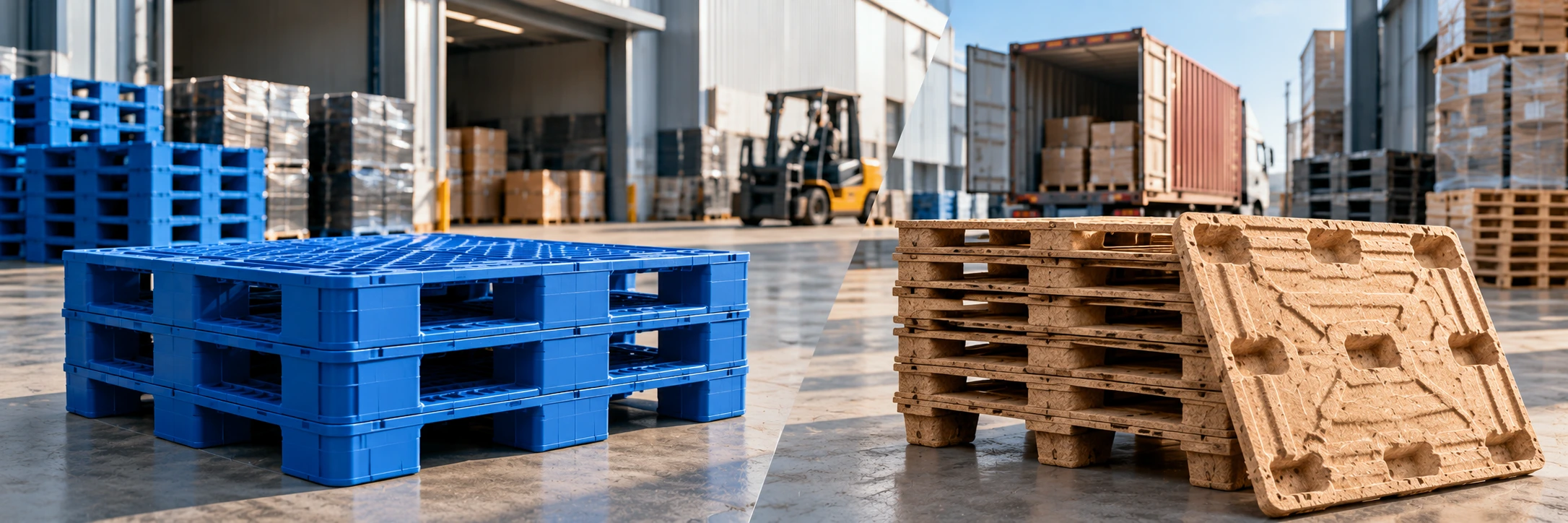
Two options keep coming up for exporters who want to avoid the heat treatment and stamping that normal wooden pallets need: plastic pallets and compressed wood pallets.
Both can work well. They are built for different jobs. This guide compares them side by side so you can pick the right one for your product, your route and your budget. It is written for buyers and logistics teams in manufacturing, automotive, pharma, electronics and e-commerce.
Quick answer: which is better for export?
Neither is better in every case. The right choice depends on whether the pallet comes back.
- Choose compressed wood pallets if the pallet is shipped out with the load, you want a light one-piece pallet, and you want to avoid ISPM 15 heat treatment and stamping. They suit export lanes and light to medium loads.
- Choose plastic pallets if the pallet is reused many times, you need to wash it or keep it hygienic, or you run a closed loop between your plant, your warehouse and your customer.
If you are unsure, send us your product weight, destination and quantity. We will tell you which one fits, even if it is not the one we sell more of.
First, what is ISPM 15 and why does it matter?
ISPM 15 is the international standard for solid wood packaging used in global trade. It was created to stop pests travelling inside raw timber. A normal wooden pallet that crosses a border must be heat treated or fumigated, and carry an official ISPM 15 mark. You can read the standard on the IPPC website, and the IPPC also has a page on how ISPM 15 is implemented.
The standard is about raw solid wood. That is why exporters look at these two options:
- Plastic pallets are not wood, so ISPM 15 does not apply to them.
- Compressed wood pallets are made by pressing wood fibres or chips with a binder under heat and pressure. They are a manufactured wood product, and in most markets they are treated as processed wood rather than raw timber.
One important point: each importing country sets its own rules. Before you ship, confirm the requirement for your destination, and ask your supplier for the documents you may need.
Plastic vs compressed wood pallets: side-by-side comparison
| Factor | Compressed wood pallets | Plastic pallets |
|---|
| Material | Wood fibres or chips pressed with a binder into one piece | Moulded plastic |
| ISPM 15 | Generally treated as processed wood, so usually exempt (confirm per country) | Not wood, so not covered |
| Typical use | Export lanes, one-way or multi-trip, light to medium loads | Repeated use, closed loops, hygiene-focused handling |
| Load capacity (Copacso) | Up to 2 tons dynamic and 7.5 tons static | Varies by model; confirm the rating for your load |
| Entry | 4-way lifting | 2-way or 4-way, depending on model |
| Nesting | Stackable and nestable | Check the model |
| Cleaning | Smooth, one-piece surface; ask your supplier if repeated washing suits your use | Smooth plastic surface, easy to clean |
| Repairability | Limited | Limited |
| End of life | Recyclable | Reusable over many cycles |
7 factors to compare before you decide
1. Will the pallet come back?
This is the biggest question.
If the pallet leaves with the load and is not returned, you want a pallet that is light and low in cost per trip. That points to compressed wood.
If the pallet returns and is reused, a plastic pallet spreads its cost over many trips.
2. Export paperwork
With a compressed wood pallet, you generally avoid heat treatment and ISPM 15 stamping, but you should still check the rules for each destination and keep your supplier’s documents ready.
With a plastic pallet, there is no wood, so there is no wood packaging treatment to arrange.
3. Weight and freight
Pallet weight counts toward your shipping weight, especially on air freight and parcel-heavy lanes. Compressed wood pallets are designed to be lightweight. For plastic pallets, weight depends on the model, so ask for the actual weight of the model you plan to use, and compare it with your load.
4. Load and racking
Copacso’s compressed wood pallets are rated for up to 2 tons dynamic (while moving) and 7.5 tons static (resting on a flat floor). Plastic pallet ratings vary by model and construction, so ask for the figures for your model.
A rating for moving or floor loads is not a rating for racks. If your loaded pallets go into racks, get written confirmation of rack suitability for your load and your rack type, whichever pallet you pick.
5. Size and height
Both pallets are available in several common footprints, and the height differs. Here is how the standard sizes line up:
| Footprint | Compressed wood (L × W × H) | Plastic (L × W × H) |
|---|
| 1200 × 1000 mm | 1200 × 1000 × 130 mm | 1200 × 1000 × 145 mm |
| 1200 × 800 mm (Euro) | 1200 × 800 × 130 mm | 1200 × 800 × 145 mm |
| 1100 × 1100 mm (Asian standard) | 1100 × 1100 × 130 mm | 1100 × 1100 × 135 mm |
Those few millimetres matter. For example, a 15 mm height difference across a stack of 10 pallets adds up to 150 mm of vertical space. When you plan container or truck loading, always include the pallet height in your calculation.
6. Hygiene
Plastic pallets have a smooth surface that is easy to clean, which suits pharma, electronics and other sensitive environments. Compressed wood pallets are one-piece and have no nails or splintering boards, which also helps with cleanliness. If you plan to wash pallets often, ask your supplier whether that suits your use.
7. Cost over time
Do not compare only the price per piece. Compare the cost per trip:
- How many trips will the pallet make?
- Will it be returned, and what does the return cost?
- How much does it weigh, and what does that add to freight?
- How much storage space does it take when empty?
A lower-priced pallet that leaves with the load can cost less per trip than a costly one you never get back, while a pallet that returns and is reused many times can cost less per trip than both. Your answer depends on your route.
Which pallet fits which situation?
| Your situation | Better fit |
|---|
| One-way export shipment, pallet not returned | Compressed wood pallet |
| Air freight or weight-sensitive lane | Compressed wood pallet (check actual weights) |
| Closed loop between your plant and your customer | Plastic pallet |
| Pharma, electronics or hygiene-sensitive goods | Plastic pallet |
| Many empty pallets to store | Compressed wood pallet (nestable) |
| Heavy loads stored in racks | Get a written rack rating for either pallet before you decide |
| Not sure | Run a small pilot with both |
Common mistakes to avoid
- Assuming “exempt” means “no checks”. Rules differ by country. Confirm before you ship.
- Choosing only on price per piece. Compare cost per trip.
- Ignoring pallet height. A few millimetres change how many layers fit.
- Using a floor rating for racks. Always confirm rack suitability.
- Skipping the pilot. Test 20 to 50 pallets on a real lane before you switch your whole flow.
A simple 5-step way to choose
- Decide if the pallet comes back. This points you to compressed wood or plastic.
- Weigh your loaded pallet and compare it with the load rating.
- Check your destination’s rules and get the documents ready.
- Match the size to your cartons, container or truck, including pallet height.
- Pilot a small batch and compare damage, handling time and cost per trip.
Can Copacso supply both?
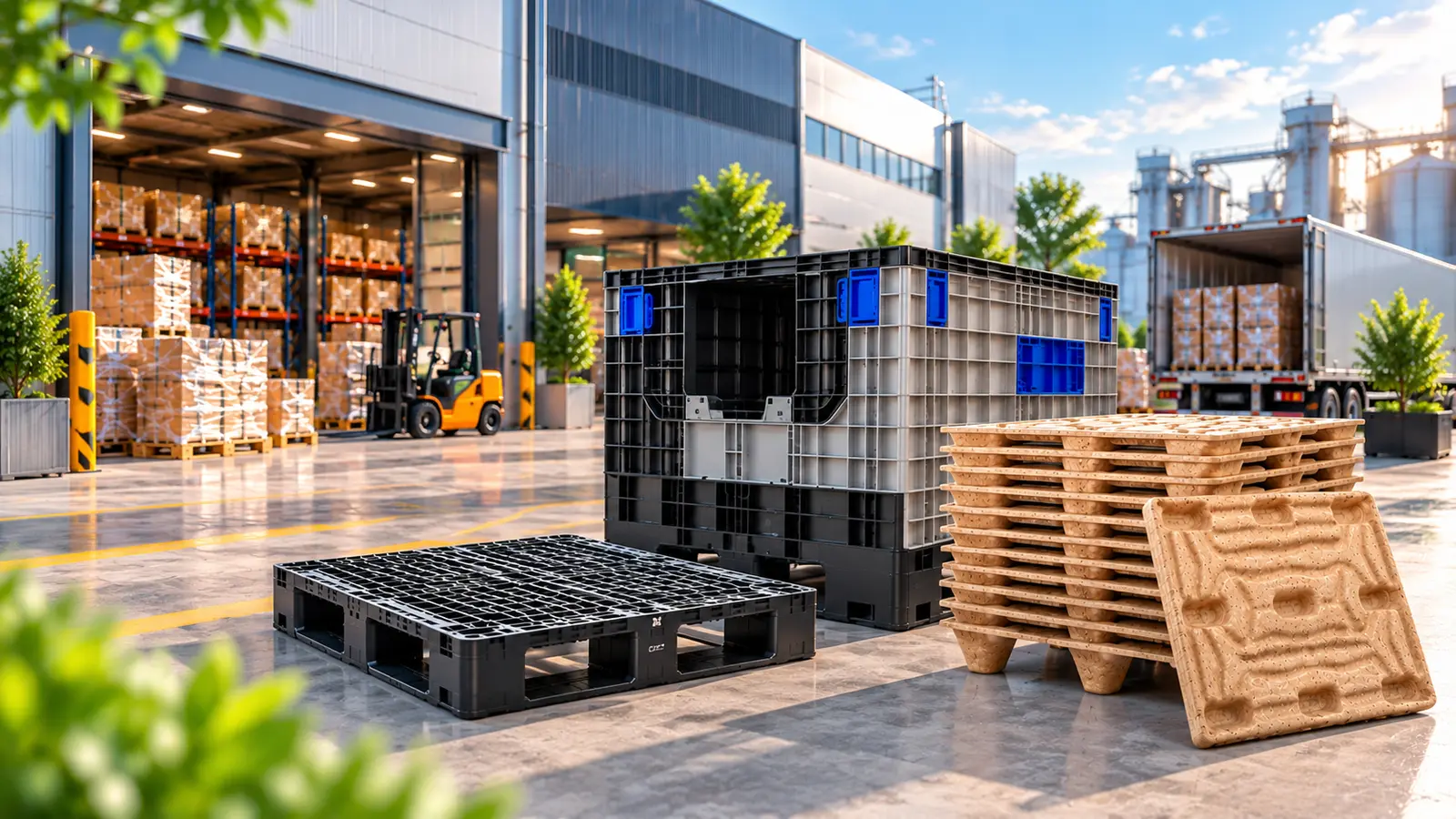
Yes. Copacso supplies both plastic pallets and compressed wood pallets, and also offers customised packaging when you need a different size or load.
Get the right pallet for your shipment
Every export lane is different. Share your product weight, destination and volume, and the Copacso team will recommend the pallet that fits your route.
Request a quote or read more in our guides: compressed wood pallets guide and how to choose the right industrial packaging.
Contact: info@copacso.com | 9549016000 G-1/274-275, Opp. Honda Cluster Zone, RIICO Industrial Area, Khushkhera, Rajasthan 301707
Copacso is a brand of Greencore Paper Conversion Pvt. Ltd.
Sources and further reading