Most packaging problems do not start at the packing table. They start earlier, when a pallet, bin or container is picked because it looks right or costs less per piece, and then fails at the first forklift, the first stack or the first return trip.
This guide gives you a simple way to choose industrial packaging that fits your product, your plant and your supply chain. It covers the six questions to ask, how the main packaging types compare, and the mistakes buyers make most often.
It is written for plant managers, purchase and logistics teams in automotive, manufacturing, pharma, electronics and e-commerce.
Quick answer: how do you choose industrial packaging?
Start with the product, not the packaging. Measure your product and its weight, then decide how it will be stored, moved and shipped. Match those needs to a packaging type, and test a small batch on a real route before you order in bulk.
In short:
- Heavy or bulky parts: large foldable containers or pallets
- Small parts that need sorting and picking: partition bins
- Sensitive goods that need an enclosed, protected load: plastic sleeve boxes
- Export loads on pallets: compressed wood pallets or plastic pallets
- A product that does not fit anything standard: customised packaging
The 6 questions to ask before you choose
1. What exactly are you packing?
Write down the length, width, height and weight of one unit and of one full load. Note if the product is fragile, easily scratched, sensitive to dust or moisture, or oddly shaped.
Packaging should hold the product snugly. Too much empty space lets parts move and get damaged. Too little space makes packing slow and can scratch the product.
2. How will it be handled?
Think about the tools your team uses every day: forklifts, pallet trucks, conveyors, hand picking.
- A pallet that only allows 2-way entry slows down a team that approaches from all sides.
- Bins that are too heavy when full are a safety problem for people who pick by hand.
- If your lines use automation, size consistency matters more than almost anything else.
3. How will it be stored?
Check your storage height, floor space and whether you stack loads on the floor or place them in racks.
Look for the stacking rating of any container you consider. For example, Copacso’s large foldable containers are built for stacking up to 3 high (ground plus 2). A container that cannot be stacked wastes your warehouse height.
If you plan to use racking, confirm that the pallet or container is rated for racks. A rating for floor stacking is not a rating for racks.
4. Where is it going?
Local, domestic and export shipments have different needs.
- Inside your plant: reusability, ease of handling and cleaning matter most.
- Domestic transport: stack stability and fit in the truck matter most.
- Export: check the rules of the country you are shipping to. Solid wood packaging must meet the international standard ISPM 15 (heat treatment and stamping). Plastic and processed wood such as compressed wood are generally treated differently, but each country sets its own rules, so confirm the documents you need for your destination.
5. Is it one-way or returnable?
If packaging goes out and does not come back, low cost per trip matters. If it comes back, you want it to last many trips and take up little space on the return.
This is where collapsible packaging pays off. Foldable containers and sleeve boxes fold down when empty, so a return load needs far less space than a load of rigid empty boxes.
6. What is the real cost?
Do not compare only the price per piece. Compare the cost over the life of the packaging:
- How many trips will it make?
- How much damage does it prevent?
- How much space does it save in storage and in return transport?
- How much time does it save your team?
A packaging item that costs more but lasts for years and protects your product often costs less per trip than a cheap one used once or twice.
Industrial packaging types compared
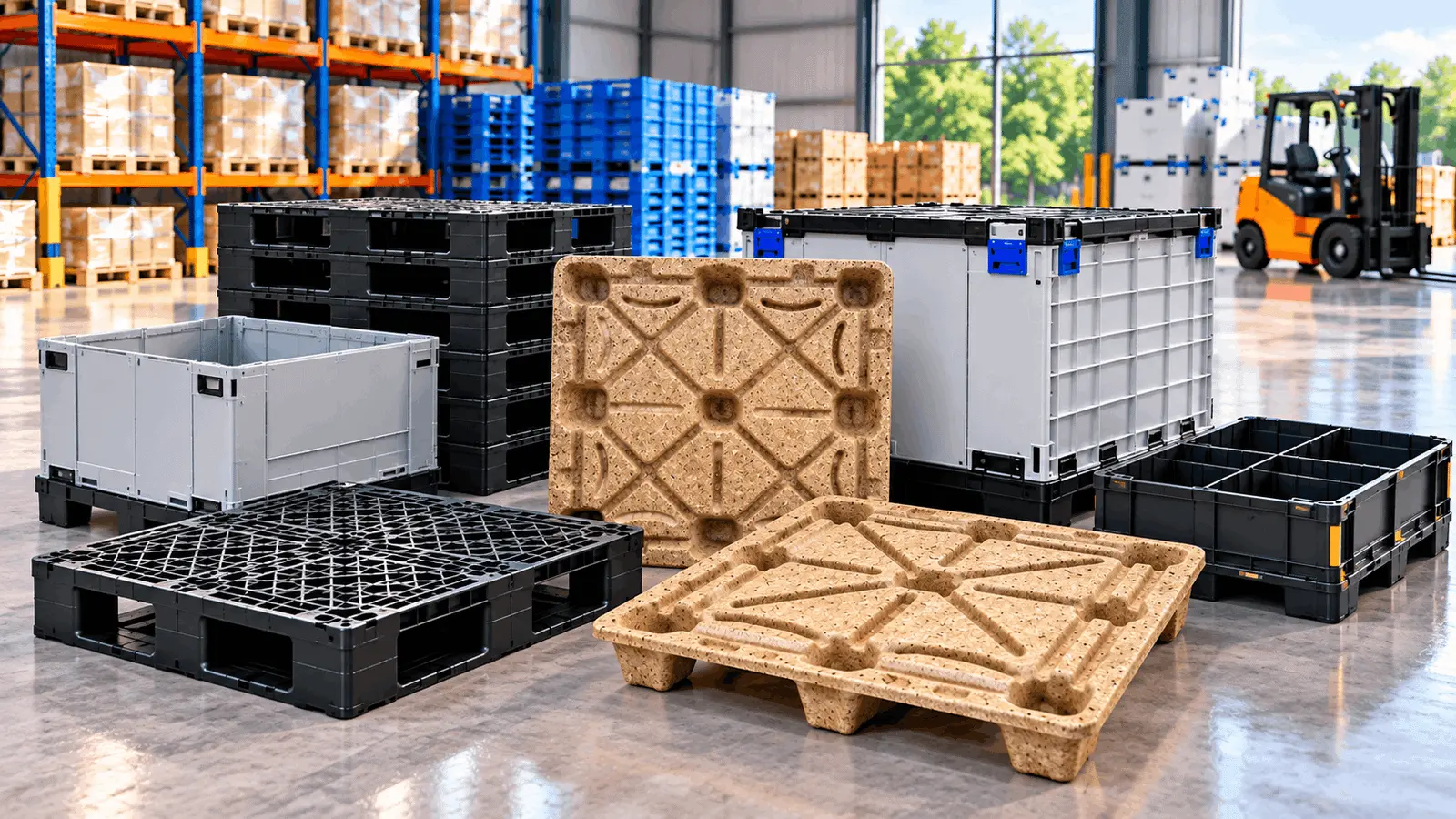
Here is how the main packaging solutions compare. The details below come from Copacso’s product specifications.
| Packaging type | Best for | Key facts |
|---|
| Compressed wood pallets | Export and lightweight pallet loads | Up to 2 tons dynamic and 7.5 tons static load; 4-way lifting; stackable and nestable; reusable and recyclable |
| Plastic pallets | Repeated use in warehouses and production | Euro, standard industrial, Asian standard and US-standard sizes; 2-way or 4-way entry depending on model; smooth surface that is easy to clean |
| Large foldable containers | Bulky parts and components | Folds flat when empty; stackable up to 3 high; load bearing capacity of 500 to 1000 kg; multiple sizes on 1200 × 1000 and 1160 × 1160 mm footprints |
| Plastic sleeve boxes | Protected, enclosed loads | Plastic pallet, collapsible sleeve and lid; forklift compatible; eight sizes from 800 × 600 to 1350 × 1150 mm; size customisation available |
| Partition bins | Small components and picking | Compartments that keep parts separated and easy to identify; six sizes from 415 × 300 × 75 mm to 615 × 400 × 313 mm |
| Customised solutions | Products that do not fit standard sizes | Dimensions, load requirements and internal layout built around your product |
Plastic pallets or compressed wood pallets?
This is the most common question we hear, so here is a plain answer.
Choose compressed wood pallets when you ship goods abroad and want a light, one-piece pallet without nails, that is stackable and nestable, and that is generally treated as processed wood for export purposes.
Choose plastic pallets when the pallet stays in a closed loop inside your plant or between known sites, goes through many cycles, and needs to be washed or kept hygienic.
Read more in our guide to compressed wood pallets.
Foldable containers or sleeve boxes?
Both fold down to save space, but they suit different loads.
Foldable containers suit bulky parts and components that are handled and stacked inside the plant or between plants.
Sleeve boxes suit loads that need a closed, protected enclosure on a pallet, because the system includes a plastic pallet, a protective sleeve and a lid.
Which industries use what?
Packaging needs change from one industry to the next. These are common matches.
- Automotive: Foldable containers and partition bins protect components during storage and movement between plants.
- Manufacturing: Pallets and containers support material flow between production lines, stores and dispatch.
- Pharma and healthcare: Clean, easy-to-wipe plastic surfaces and organised handling are the priority.
- E-commerce and retail: Reusable pallets and containers keep stock organised through fulfilment and distribution centres.
- Electronics and electrical: Share your part sizes and handling process, and the team can recommend the right bins, containers or pallets for your line.
5 mistakes to avoid when buying industrial packaging
- Choosing by price per piece. Always compare cost per trip over the life of the packaging.
- Ignoring the whole route. A container that works in your plant may not fit your truck, your customer’s dock or your customer’s racks.
- Mixing too many sizes. A small number of standard sizes makes stacking, storage and planning much easier.
- Skipping the pilot. Always test 20 to 50 pieces on a real lane before you switch your whole flow.
- Forgetting the return trip. If packaging comes back, plan for how it comes back and how much space it takes.
A simple 5-step process to follow
- Measure your product and a full load: dimensions, weight and handling needs.
- List how it is stored, moved and shipped, and who receives it.
- Shortlist two or three packaging types from the table above.
- Pilot a small batch on a real route and note damage, handling time and space used.
- Scale up once the pilot works, and keep your size range small.
Get help choosing the right packaging
Every plant has its own product, handling process and route. If you share your product details, the Copacso team can recommend a packaging solution that fits your operation.
Request a quote or explore all Copacso solutions.
Contact: info@copacso.com | 9549016000 G-1/274-275, Opp. Honda Cluster Zone, RIICO Industrial Area, Khushkhera, Rajasthan 301707
Copacso is a brand of Greencore Paper Conversion Pvt. Ltd.